
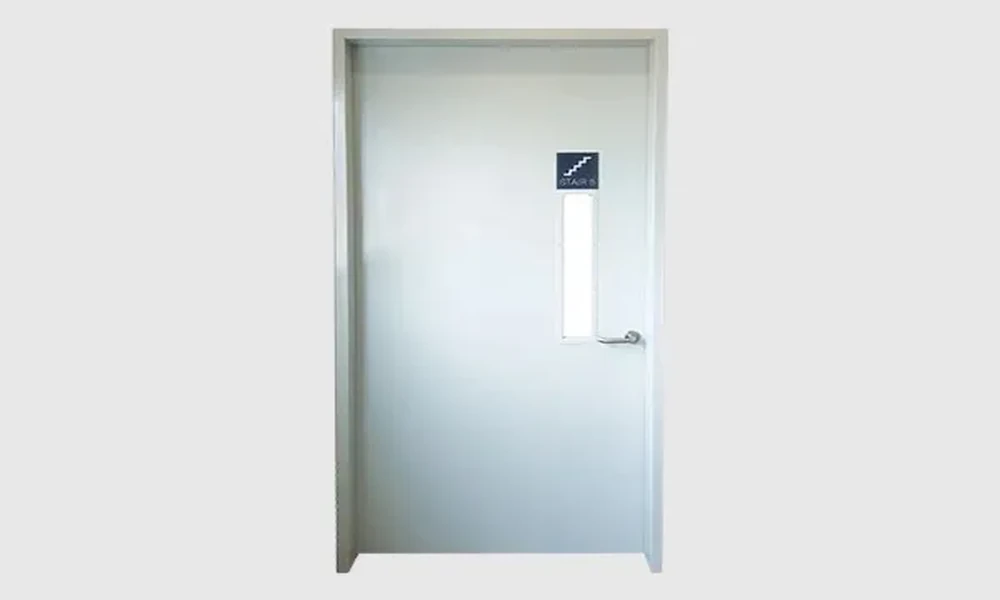
Where a fire door has to survive genuinely demanding conditions a transformer room, a service riser, a loading bay, an escape stair in an industrial building timber reaches its limits fairly quickly. Steel assemblies take over at that point, offering higher ratings, better durability under heavy use and resistance to conditions that would destroy a timber leaf within a few years. Understanding where a metal fire rated door in Singapore is the right answer, and what to check when specifying it, avoids both over-specification and the more expensive mistake of under-specifying.
What Steel Assemblies Are Built From
A steel fire door is a fabricated assembly rather than a solid slab. The leaf consists of formed steel sheet skins over a frame, with the cavity filled with a fire-resistant core such as mineral wool, honeycomb or a proprietary insulating material. The frame is pressed steel, anchored into the structural opening. Intumescent seals fitted into the frame or leaf edge expand under heat to close the gap as the door and frame distort. Hinges are heavy-duty and rated for the leaf weight, and hardware is selected from configurations included in the original fire test.
Where Steel Is the Right Choice
Certain applications call for it almost by default. Plant rooms, generator rooms, transformer rooms and switch rooms combine high fire load with heavy equipment movement. Service risers and ducts need durable closure across many floors. Loading bays and back-of-house corridors see constant trolley traffic that would damage timber quickly. External openings and semi-exposed locations face weather that timber tolerates poorly. Industrial premises need doors that survive impact and keep operating. In each case durability matters as much as the fire rating itself.
Reaching Higher Ratings
The clearest technical advantage is achievable resistance. Timber assemblies are practical up to moderate ratings, but requirements beyond that push toward steel. Where a compartment separation or a high-risk enclosure demands extended resistance, a certified steel assembly provides ratings that timber construction cannot reach. This matters most in industrial buildings, plant enclosures and separations between occupancies with very different fire loads, where the specification comes directly from the building’s fire safety strategy rather than from preference.
Durability Over the Building’s Life
Fire doors are rarely treated gently. In busy buildings they are struck by trolleys, pushed open with equipment, and operated thousands of times a year. Timber leaves absorb that punishment through dented lippings, split edges and damaged seals, and repairs must use approved components or the certification lapses. Steel assemblies tolerate impact far better, resist moisture in wash-down areas and plant rooms, and maintain the dimensional stability that keeps clearances within tolerance. Over a twenty-year life the difference in maintenance and replacement cost frequently outweighs the higher initial price.
Insulation Versus Integrity
A distinction worth understanding when comparing options is between integrity and insulation. Integrity refers to the assembly’s ability to prevent the passage of flame and hot gases. Insulation refers to limiting the temperature rise on the unexposed face, which protects anyone escaping past the door and prevents ignition of materials on the far side. Not every certified door provides both, and requirements vary by application. Check which performance criteria the specification calls for and confirm the certificate covers them, rather than assuming a minute rating implies both properties.
Hardware and Configuration Limits
Certification applies to a tested configuration, and steel assemblies are no exception. Maximum leaf dimensions, permitted glazing area, allowable hardware and the number of hinges are all defined by the test evidence, and a fire rated door supplier in Singapore should state each of them on the certificate. Double-leaf sets require correctly specified meeting stiles and coordinated closing devices so the leaves close in the right sequence. Vision panels need approved glazing, beads and intumescent tape. Panic and emergency exit hardware on escape routes carries its own tested requirements. Substituting any of these on site even with a component that seems equivalent puts the rating at risk.
Appearance and Finishes
The assumption that steel means industrial appearance is outdated. Powder-coated finishes are available in a wide colour range and hold up well against scuffing. Frames can be profiled to suit architectural details, and vision panels break up larger leaves visually. Where a door sits in a public-facing area, these options allow steel to be used for its performance without an institutional look. That said, in areas where matching adjacent joinery is the priority, timber assemblies will usually integrate more naturally.
Installation Requirements
Steel frames are heavier and demand correct anchoring the fixing type, size and spacing specified in the certification, into a substrate capable of carrying the load. Perimeter gaps need proper fire stopping filled to depth rather than sealed at the surface. Clearances between leaf and frame must sit within a few millimetres, and threshold gaps within their own limit. Closers require adjustment so the door closes fully and latches from any position, which takes more force with a heavier leaf. Engaging a specialist fire rated door contractor in Singapore for installation avoids the fixing and clearance errors that commonly appear when general trades handle this work.
Inspection and Upkeep
Steel doors still need periodic checking. Confirm the leaf closes and latches from any angle, hinges are secure and not dropping, seals are continuous and unpainted, and no hold open wedges have been introduced. Look for corrosion at the base in wet areas and touch up damaged coating before it spreads. Repairs should use approved components matching the certified configuration. With that modest attention, a steel assembly typically outlasts several timber replacements in the same opening which is the practical argument for specifying it wherever conditions are demanding.
