
Anyone who has lived through a bathroom rebuild remembers the dust more than the plumbing. Concrete dust is exceptionally fine, it travels through door gaps and air conditioning ducts, and it settles on every horizontal surface in the property including inside wardrobes and electronics. Weeks after the contractor has left, it is still appearing. For occupied homes and operating businesses, that consequence often matters as much as the repair itself which is why low-dust methods have become a mainstream option rather than a niche one.
Where the Dust Actually Comes From
The mess is a by product of demolition, not of waterproofing. Removing tiles with a chisel, breaking up screed and grinding back a slab all generate airborne particulate at volume. A single bathroom strip-out can produce a surprising quantity of fine silica dust, which is both a nuisance and a genuine respiratory hazard. Because the traditional sequence requires exposing the structural slab before a new membrane can be applied, the demolition is unavoidable within that approach. Reduce or remove the demolition, and the dust problem largely disappears with it.
What the Low-Dust Approach Replaces
The alternative works with the existing surface rather than removing it. Where the substrate is sound, treatment is applied over the current finish or through small access points, using crystalline slurries, injected resins or liquid-applied membranes. Crystalline products penetrate the concrete and grow crystals within its capillaries, blocking water movement from inside the material. Injection resins fill cracks and voids under pressure. Liquid membranes cure into a continuous seamless layer over the prepared surface. A dustless waterproofing system uses whichever of these suits the substrate, combined with dust-extracted tools where any drilling is required.
The Practical Difference on Site
The change in day-to-day experience is significant. There is no skip outside the building and no debris carried through corridors. Furniture in adjacent rooms does not need to be sheeted or removed. Air conditioning can usually keep running instead of being shut down to prevent dust circulation. Noise drops from continuous percussion to intermittent drilling, which matters in condominiums with restricted working hours. Most importantly the timeline compresses a job measured in weeks becomes one measured in days, because there is no demolition, no waste removal, no curing of new screed and no retiling.
Why Occupied Properties Benefit Most
For an empty unit being renovated end to end, dust control is a convenience. For an occupied property it can be the deciding factor. Families with young children or anyone with asthma or respiratory sensitivity have a real health reason to avoid silica dust indoors. Home offices cannot function alongside demolition. In commercial premises the calculation is sharper still, a restaurant cannot serve food in a dusty environment, a clinic cannot maintain hygiene standards, and an office cannot ask staff to work through it. Being able to complete the work while the space stays in use often outweighs any difference in price.
Substrate Condition Sets the Limits
The method depends on having something sound to work with. If tiles are drummy and lifting across the floor, or the screed beneath has broken down, applying a new layer over the top will not last. Severely spalling concrete needs repair before any membrane will bond. Where an existing membrane has failed comprehensively rather than at isolated points, partial treatment leaves the rest of the defect in place. A proper assessment establishes whether the substrate can carry the new system, and an honest contractor will tell you when conventional reconstruction is genuinely the better long-term choice. The same judgement applies to waterproofing for roofs, where a membrane degraded across its whole area rarely responds to an overlay.
Matching Method to Location
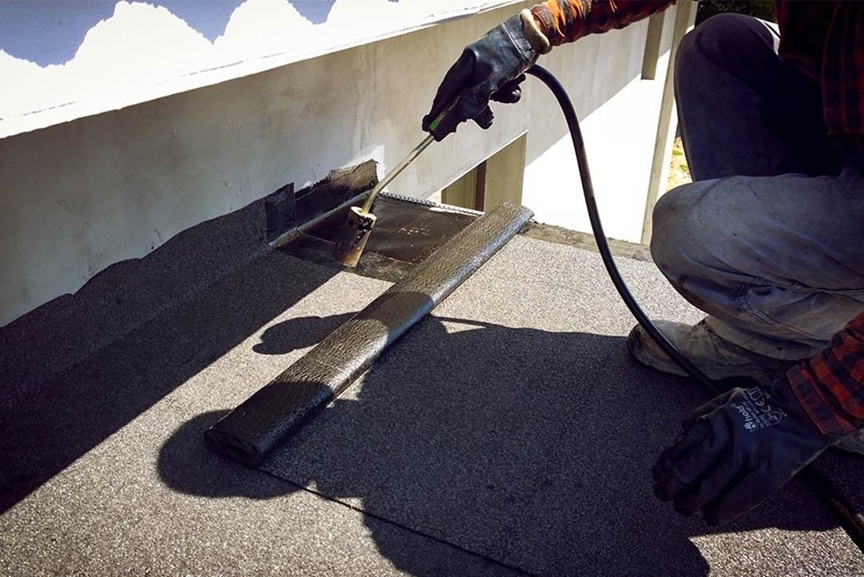
Different areas call for different systems. Bathroom floors and shower zones need a membrane that tolerates constant wetting and movement at junctions. Balconies and planter boxes face UV exposure and thermal cycling, which demands a more elastic product. Basements and lift pits deal with negative-side water pressure, where crystalline treatments perform well because they work within the concrete rather than relying on a surface bond. External roof areas involve their own material considerations around ponding, foot traffic and expansion joints.
Preparation Still Matters
Low dust does not mean no preparation. Surfaces must be cleaned thoroughly, existing sealants and loose material removed, and cracks routed and filled before the system is applied. Coving at wall-floor junctions, detailing around floor traps and reinforcement at penetrations all need proper attention, because these transitions are where most failures begin. Skipping detailing to save time produces a repair that looks complete and leaks within a year. Ask what preparation is included in the quotation rather than assuming it.
Choosing a Contractor
Look for someone who inspects before quoting, names the specific products they intend to use, and provides a written warranty with defined terms. Photographs of the substrate condition and the completed application give you a record if questions arise later. Because the method is applied over existing finishes, verification matters ask how the repair will be tested before handover, whether by ponding test or moisture readings. Established specialists in waterproofing in Singapore will have a standard testing protocol and will explain it without prompting.
Weighing It Up
The case for a low dust approach rests on total disruption rather than headline price. Compare not just the quotation but the days out of use, the cleaning afterwards, the temporary arrangements and the effect on anyone else in the building. For a sound substrate with a localised or moderate defect, avoiding demolition usually wins on every measure that matters to the people living or working in the space.
