
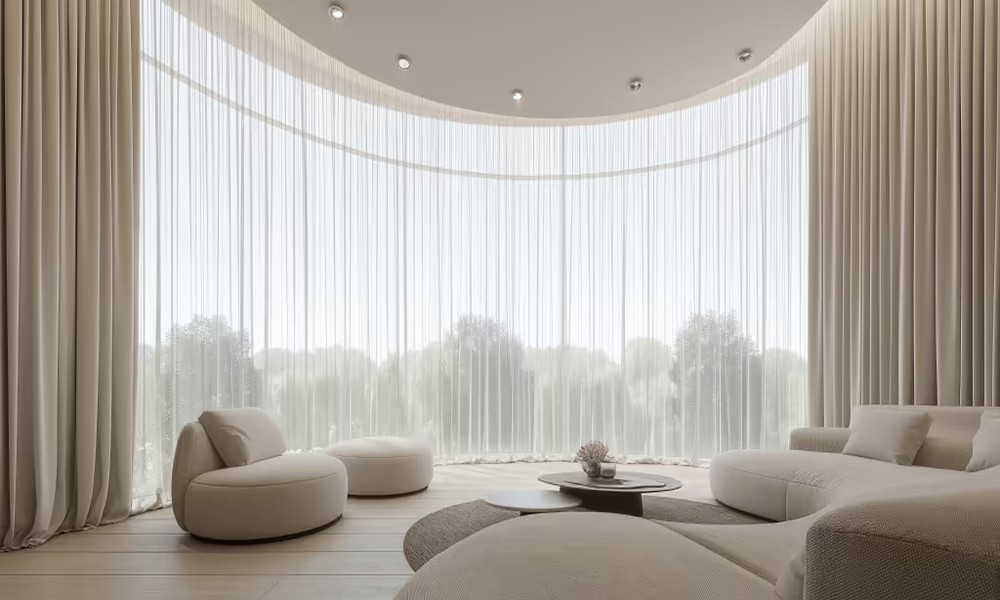
Wave fold curtains bring a particular quality to a room that most window treatments cannot match: they make a wall of fabric look effortless, like something that has always belonged there.
The Design Logic Behind the Wave
Unlike conventional pleated curtains that create sharp, defined folds, wave fold curtains – also known as S-fold curtains – use a continuous, shallow wave pattern formed by evenly spaced carriers on a specially designed track. The result is a soft, undulating fall of fabric that reads as sculptural rather than merely functional. The wave is uniform from top to bottom, which gives the curtain a precision that suits the clean lines of contemporary interior design.
This consistency is achieved through a fixed spacing system. Carriers on the track hold the fabric at regular intervals, and the spacing between them determines the depth of each wave. A tighter spacing creates a shallower, more subtle wave. A wider spacing produces a fuller, more dramatic fold. The choice depends on the fabric weight and the visual density that suits the room.
Why Contemporary Homes Favour This Style
Modern interior design in Singapore tends toward restraint. Clean surfaces, minimal ornamentation, and a preference for materials that age gracefully are hallmarks of the contemporary residential aesthetic that dominates new developments and renovation trends across the island. Wave fold curtains align with this aesthetic because they add warmth and softness to a room without competing with the architecture.
In contrast to pencil pleat or eyelet curtains, which draw attention to their own structure, the S-fold design draws attention to the fabric itself – its colour, texture, and the way it responds to natural light. In a room where every other element has been carefully considered, this visual discipline is an asset.
Fabric Selection and Its Effect on the Wave
The success of a wave fold curtain depends heavily on the fabric chosen. Not every material behaves the same way on a wave track:
- Lightweight sheers: produce a fluid, barely-there wave that filters light gently while maintaining transparency
- Medium-weight linens and blends: create a more defined wave with visible structure and good drape
- Heavyweight velvets and chenilles: produce a deep, rich wave that blocks light effectively and insulates the room
- Blackout-lined fabrics: add thermal and light-blocking properties while maintaining the wave profile at the front
The fabric weight must also be compatible with the track system to ensure the carriers slide freely and the wave remains consistent across the full width of the curtain panel.
Track and Hardware Considerations
Wave fold curtains require a dedicated track system, not a standard rod. The track is typically recessed into the ceiling or mounted on a ceiling-fixed bracket for a clean, floating appearance. This ceiling-mounted approach is a key part of why these curtains look the way they do: with no visible hardware, the fabric appears to originate from the ceiling itself, making the room appear taller.
“Good design creates order from chaos and adds value to everything it touches.” – Lee Kuan Yew.
This principle holds for window treatments as much as for any other designed element. A well-specified track and fabric combination, installed with attention to ceiling height and wall width, transforms a window from an aperture into a feature.
Practical Advantages Beyond Aesthetics
The aesthetic case for S-fold curtains is clear, but their practical advantages are equally significant:
- Easy operation: the wave track allows the curtain to stack compactly when open, maximising the amount of natural light that enters the room
- Smooth travel: the carrier system reduces friction and allows the curtain to open and close without bunching
- Motorisation compatibility: wave fold tracks integrate cleanly with motorised drive systems for automated operation, which is increasingly sought in Singapore’s smart home market
- Low maintenance: the smooth, unpleated surface of the fabric accumulates less dust than tightly gathered curtains and is easier to clean
Installation in Singapore’s Housing Context
Singapore homes range from compact HDB flats to landed property and high-rise condominiums, each presenting different window configurations. The adaptability of the wave fold system to different ceiling heights, window widths, and floor-to-ceiling applications makes it one of the more versatile curtain formats for local residential use.
For modern curtain styling that holds up across different light conditions, seasons, and interior updates, wave fold curtains in the right fabric and track specification deliver elegance that improves the room rather than simply covering the window.
